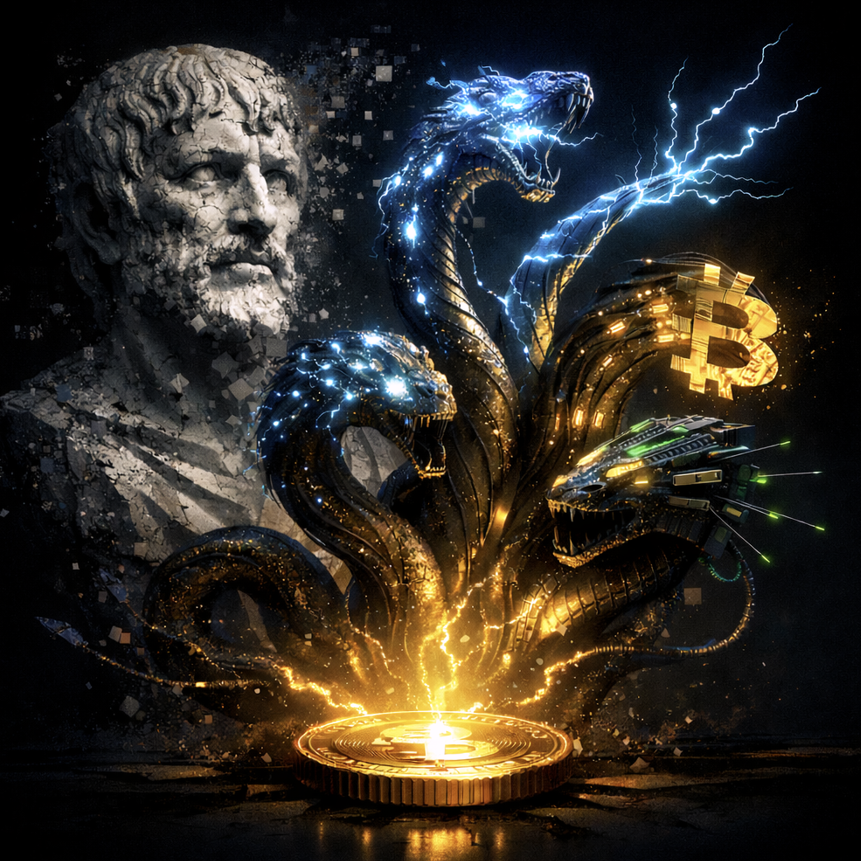
Prologue: The typo that became a philosophy
On December 18, 2013, at 10:03 UTC, a drunken Bitcoiner named GameKyuubi tripped over his own keyboard and made history. “I AM HODLING,” he typed into the Bitcointalk forum as the Bitcoin price plummeted from over $1,000 to under $500. The first sentence of his post was a confession: “I typed that title twice because I knew it was wrong the first time. Still wrong.”
What followed wasn't a trading guide, but a confession: "I'm a bad trader. I'm not going to sell. I don't care if it goes to $1. HODL." He meant "HOLD"—to hold. But the typo remained. It became a meme, a battle cry, and finally—without GameKyuubi realizing it—an acronym for a philosophy of life: Hold On for Dear Life.
But this story has deeper roots than the forum suspected. What GameKyuubi articulated with his whiskey-tinged clarity was an attitude that Epictetus had perfectly captured two thousand years earlier:
"It is not things themselves that disturb people, but their opinions about things." — Epictetus, Encheiridion
The Bitcoin price—whether one hundred dollars, one thousand, or one hundred thousand—is an external event. It lies beyond any individual control. What is within an individual's power is solely the reaction to it. GameKyuubi, without realizing it, had distilled the stoic dichotomy of control into four letters: HODL.
This text explores the architecture of an idea that extends far beyond an investment meme. It connects three strands that, at first glance, seem unrelated: ancient Stoicism—specifically Seneca, Epictetus, and Marcus Aurelius—the mathematical and economic revolution of the Bitcoin protocol, and the emerging world of autonomous AI agents and decentralized communication via Nostr. The common thread that binds these strands together is a single word: sovereignty .
Sovereignty over one's own money. Over one's own thinking tools. Over one's own communication. Over one's own needs. And—most profoundly—over one's own psyche.
Imagine Alice falling not down a rabbit hole, but down the Genesis Block. At the bottom of the shaft, she wouldn't meet the Mad Hatter, but Satoshi Nakamoto—anonymous, mathematically precise, and vanished like the Cheshire Cat. Next to him would be Hal Finney, the first recipient of a Bitcoin transaction, who tweeted "Running bitcoin" shortly before his death from ALS. And in the corner, reading a scroll, would be Seneca—the billionaire who preached frugality, the advisor to a tyrant who taught independence of mind.
These three would understand each other. Not immediately. Not without friction. But deep down, their thoughts would converge—because all three had solved the same problem: How does one live freely in a world that systematically undermines freedom?
Satoshi solved it with code: a protocol that replaces trust with mathematics. Hal Finney solved it through action: he was the first to translate theory into practice—and held onto his coins until his dying breath. Seneca solved it with philosophy: an art of living that liberates humanity from the tyranny of external circumstances.
This book is an attempt to bring these three solutions together. Not as an academic exercise, but as a user manual for a world that is increasingly volatile, complex, and centralized—and for the few who go deep enough down the rabbit hole to recognize the architecture of an alternative.
◆ ◆ ◆
PART ONE
THE ARCHITECTURE OF INNER FREEDOM
Stoicism as an operating system for the digital age
Chapter 1: The Dichotomy of Control — and Why It Changes Everything
The central insight of Stoicism can be summarized in a single sentence that sounds so simple its explosive power is easily overlooked: There are things that are within your power and things that are not. Epictetus formulated this distinction as the foundation of his entire thought. Within your power lie your judgments, your impulses, your desires, your aversions—in short, everything that is your own doing. Outside your power lies everything else: your body, your possessions, your reputation, your position, and especially external events such as the weather, politics, or markets.
This distinction is not merely philosophical theory. It is an operating system for life. And it is—this is the thesis of this chapter—the most precise mental model a Bitcoiner can possess.
Let's consider the reality of someone buying their first satoshis in 2024. Virtually everything that keeps them up at night is beyond their control: the Bitcoin price tomorrow, next week, next year; media coverage, whether gloating or euphoric; regulatory decisions in Beijing, Washington, or Brussels; what others are doing—whether they're buying, selling, or spreading FUD; macroeconomic earthquakes like inflation, interest rate reversals, and banking crises; and the movements of anonymous whales who can move the market with a single transaction.
However, he has a surprisingly powerful handful under his control: his decision to buy or not; how much he buys relative to his wealth; his strategy — whether DCA or a one-off investment; the custody of his coins — the choice between sovereignty and dependence; his reaction to price movements; his knowledge of the protocol; and his time preference — the fundamental orientation towards short-term or long-term horizons.
Most Bitcoin newcomers invest ninety percent of their energy in things beyond their control. They check the price hourly. They devour every headline. They follow influencers on Twitter as if their opinions were oracles. They try to time the market—to control the uncontrollable. The result is predictable: stress, anxiety, and disastrous decisions.
The stoic investor does the opposite. He accepts: The price will do what it does. I can't influence it, so I don't waste energy watching it. Instead, he asks himself: Do I truly understand the protocol? Is my hypothesis sound? Have I kept my coins safe? Is my allocation chosen so that I could survive even a total loss?
This is not passive resignation. It is radical focus. And, paradoxically, it is the only strategy that works in the long run.
The Illusion of Market Timing
One of the most persistent misconceptions among investors is: "I'll wait for a better price." They see Bitcoin at $60,000 and think: Too expensive. I'll buy in when it drops to $40,000. This strategy sounds reasonable. However, it implies an assumption that is not empirically sound: that you can time the market. That you can predict when prices will fall and when they will rise.
The data tells a different story. Studies consistently show that the average investor who tries to optimize entry and exit points performs significantly worse than someone who simply invests and holds. The reason is psychological: people buy when they're euphoric and sell when they're panicking—the exact opposite of what would be rational. With Bitcoin, where volatility is more extreme than with any other major asset, this effect is dramatically amplified.
The stoic answer is dollar-cost averaging: Buy a fixed amount at regular intervals, regardless of the price. One hundred euros every month, whether Bitcoin is at twenty thousand or sixty thousand. This strategy is stoic in several ways. It eliminates emotional decisions. It accepts the uncontrollability of price. It focuses on what is controllable—disciplined saving. And it is radically long-term oriented: Time in the market beats market timing.
“Nature does not hurry, and yet everything is completed.” — Laozi — but the Stoics would have agreed.
Chapter 2: Volatility as Initiation
Bitcoin is the most volatile major asset in world history. In its fifteen years of existence, it has experienced crashes that would have devastated any other market: down 93 percent in 2011, down 87 percent between 2013 and 2015, down 84 percent after the 2017 hype, and down 77 percent during the crypto winter of 2022. Each time, the media, economists, and governments declared Bitcoin dead. Each time, it recovered and reached new highs.
For the Stoic thinker, this volatility is not a defect, but a test. Seneca wrote: "Fire tests gold, misfortune tests strong men." Bitcoin's crash cycles are this fire. They separate "weak hands"—those who panic and sell at a 50% drop—from "strong hands"—those who buy more at a 50% drop.
But the theory goes deeper. Volatility isn't just a test—it's the price of potential. An asset that can increase a thousandfold must also be able to fall by eighty percent. Without crashes, there would be no life-changing returns. Without mass fear, there would be no opportunities for the bold. Those who want a hundredfold return must be able to withstand an eighty percent loss. This isn't a bug. This is the fundamental architecture of asymmetric risk.
Amor Fati: Embracing Volatility
Amor fati—love of fate—is perhaps the most radical doctrine of Stoicism. Nietzsche popularized the term, but the idea is older: Don't just accept what happens. Love it. Embrace it as necessary and good.
Marcus Aurelius put it this way: “Love only what is given to you and spun into your lap by fate. For what could be more fitting?” Applied to Bitcoin, this means: love the crash. Not in a masochistic sense, but in the recognition that it is necessary for the opportunity. March 2020 is the perfect example. Bitcoin fell from nine thousand to three thousand eight hundred dollars in twenty-four hours—a loss of fifty-eight percent. Those who sold out of fear that night realized their loss permanently. Those who thought, “This is perfect,” and bought more that night saw their price rise to sixty-nine thousand dollars within twenty months.
The Cupid's arrow reaction isn't wishful thinking. It's a shift in perspective. Every major Bitcoin whale that has survived multiple cycles confirms this: the best purchases felt the worst. Buying at twenty thousand when everyone is shouting "it's going to zero" is emotionally terrible—and economically optimal.
The four-year cycles: Order in apparent chaos
Despite its volatility, Bitcoin exhibits remarkable regularity. Every 210,000 blocks—roughly every four years—the block reward for miners is halved: the halving. Historically, each halving has been followed by a bull market, then a crash, then sideways movement, followed by the next halving. November 2012 led to the high at the end of 2013. July 2016 led to the high at the end of 2017. May 2020 led to the high at the end of 2021.
The Stoics believed in cosmic order—the Logos, the rational principle underlying apparent chaos. Heraclitus, a precursor of Stoicism, formulated it as "Panta rhei"—everything flows. Nothing is permanent. Neither the bull market nor the bear market. Marcus Aurelius wrote: "Time is a river of rushing events." What is up today is down tomorrow. What is down today is up tomorrow.
The weak trader sees only the present: "Bitcoin is at $60,000—I have to buy!" at the peak, or "Bitcoin is dying!" at the bottom. The stoic investor sees the cycles: We are in the late bull market. This will correct. In the long run, it will go higher. I will hold through the entire cycle. This ability to recognize the pattern in chaos without claiming control over it—that is stoicism in its truest sense.
Chapter 3: Time Preference — The Marshmallow Test of Civilization
Time preference is an economic concept of civilizational significance. It measures how strongly a person prefers present rewards to future ones. High time preference means: I want everything immediately. Consume today, pay tomorrow. Low time preference means: I can wait. Save today, consume tomorrow.
Walter Mischel's famous marshmallow test made this concept tangible: A child is given one marshmallow. They can eat it immediately—or wait fifteen minutes and get two. The children who waited were later—measured over decades—more successful in virtually every measurable dimension: better grades, higher incomes, more stable relationships, healthier lives.
Bitcoin is the ultimate time preference test. High time preference: Buy at 30k, sell at 50k – 16% gain in three weeks! Then taxes and trading fees apply, leaving perhaps ten percent net profit. Then the next trade goes wrong. Low time preference: Buy at 30k, hold for ten years. It doesn't matter if it drops to 50k or rises to 100k in the meantime. After ten years, if the hypothesis proves correct, it will be worth many times that amount.
“Nothing of value comes into being suddenly, no more than a grape or a fig. If you say to me now, ‘I want a fig,’ I will reply, ‘That takes time.’” — Epictetus
How fiat currencies generate high time preference
Fiat currencies—dollars, euros, yen—are architecturally designed for devaluation. When money loses three to five percent of its purchasing power annually, officially, or ten to fifteen percent in real terms, saving is penalized. The rational response: spend it or invest it in nominal assets—stocks, real estate, anything that appreciates nominally while the currency falls.
This mechanism creates a culture of impatience. Credit instead of saving. Consumption instead of restraint. Short-term gains instead of long-term planning. Seneca warned against "luxuria"—not out of morality, but out of pragmatism: Excessive luxury breeds addiction. Those who become accustomed to excess become slaves to their habits. Fiat inflation systematically promotes this enslavement.
Bitcoin reverses the incentive structure. As a disinflationary asset—limited to less than 21 million units with increasing demand—it rewards saving. Every satoshi will represent more purchasing power in the long run. This creates a low time preference: Why consume today when there will be more purchasing power tomorrow? Why trade when holding performs better? This is not merely economically significant, but also culturally important. A society with a low time preference thinks in terms of generations. One with a high time preference thinks until the next election.
The power of patience — and why inaction can be the best action.
A thought experiment: Person A buys Bitcoin for €1,000 at €100 per coin. They trade actively, winning some trades and losing others. After ten years, they own eight Bitcoins. Person B buys at the same price, puts their hardware wallet in a drawer, and almost forgets about it. After ten years, they still own ten Bitcoins. At a hypothetical price of €50,000, Person B has €500,000, and Person A has €400,000. Person B has 25 percent more—not despite, but because they did nothing.
“We suffer more in our imagination than in reality.” — Seneca, Epistulae Morales 13
The trader suffers from constant stress: Did I make the right decision? Will it continue to rise? Will it fall? The HODLer has made a single decision—and rests. Their patience is not a weakness. It is the highest form of economic discipline.
Chapter 4: Practical Stoic Techniques for the Digital Investor
Premeditatio Malorum: Anticipating the worst
The most powerful Stoic technique bears the beautiful name Praemeditatio Malorum—the premeditation of evil. Seneca practiced it regularly: once a month he lived like a poor man. The simplest food, a hard mattress, no comforts. Not out of self-flagellation, but out of strategic preparation: those who have experienced poverty no longer fear it.
Adapted for Bitcoin: Visualize your entire investment dropping to zero, or the classic boating accident. Quantum computers break cryptography. Governments ban Bitcoin worldwide and enforce the ban. Everything is gone. Now ask yourself: Would I be finished? If the answer is yes, perhaps you lack the skills to create value in the market to generate a regular income? If no: Good. You can remain calm because even the worst-case scenario is tolerable.
This exercise isn't morbid. It's liberating. Those who have considered the worst-case scenario have nothing left to fear. The stoic, who has already mentally rehearsed a 90% crash, reacts calmly when a 30% crash occurs: "Scenario C. I have a plan for that." The unprepared, on the other hand, capitulate.
The 48-hour rule
The most important practical rule for every Bitcoiner: Don't make decisions in an emotional state. If you're afraid: don't sell. If you're euphoric: don't go all-in. If you're angry: don't trade.
The technique: When the impulse arises to buy or sell outside your plan, wait forty-eight hours. Write down the impulse: "I want to sell because the price is falling and I'm scared." After two days, read it again. In most cases, the impulse will have subsided. The emotion will have calmed down. The irrationality will become apparent.
Viktor Frankl, a survivor of Auschwitz, formulated this insight universally: “Between stimulus and response there is a space. In that space lies our power to choose.” The 48-hour rule expands this space. It is freedom in its purest form.
Daily Reflection: The Investor's Diary
Marcus Aurelius kept a diary—the "Meditations," which have survived as one of humanity's greatest philosophical texts. Every morning and evening he reflected. An adapted ritual for the digital investor could look like this:
Three minutes this morning: Whatever the price does today is beyond my control. My thesis remains unchanged: decentralized, scarce, censorship-resistant money. Today I will not act impulsively. I will focus my energy on what I can control: learning, working, living.
Three minutes in the evening: Did I act out of fear or greed today? Did I follow my plan? What did I learn about Bitcoin, about myself, about dealing with uncertainty?
This daily reflection creates distance between impulse and action. In the long run, this distance is the difference between the impulsive trader who loses and the reflective investor who wins.
◆ ◆ ◆
PART TWO
THE ECONOMY OF SELF-SUFFICIENCY
Bitcoin, Lightning, and the Reorganization of Value Creation
Chapter 5: Lightning Network — The interest rate market without a central authority
The Lightning Network represents an innovation whose full implications are not yet apparent to most. It enables Bitcoin transactions on the order of millisatoshis—one thousandth of a satoshi, equivalent to roughly one hundred millionth of a Bitcoin—virtually free of charge and with instantaneous completion. What appears to be a technical upgrade is a qualitative transformation: the elimination of friction losses that have always systematically disadvantaged small players.
Traditional financial systems operate with significant friction: transaction fees, waiting times, minimum amounts, intermediaries. Each layer takes its share. The Lightning Network eliminates these layers and creates a market where even the tiniest units of value can be moved efficiently.
"Avaritia non minuit, sed auget divitias." — Greed does not diminish wealth, but increases it. — Seneca
Seneca's paradox finds unexpected confirmation here: In the Lightning Network, value creation is achieved not through greed, but through intelligent automation. Node operators earn routing fees by providing liquidity in payment channels. These fees are essentially interest on provided capital—in a completely free, unregulated market without a central authority. The returns may be nominally small. But they are paid out in a deflationary asset. And they are based on complete sovereignty: You control your capital; no one can freeze it.
A three percent interest rate on Bitcoin that you hold yourself and over which you have complete control is categorically superior to a ten percent interest rate on a bank account that can be frozen at any time. Seneca would have called that "vera libertas"—true freedom.
AI agents as liquidity managers: The Hydra of automation
Managing Lightning liquidity is complex: channels must be balanced, fees dynamically adjusted, and new connections strategically opened. These tasks require continuous attention and decision-making—ideal prerequisites for AI agents.
So-called "Lightning agents" can use machine learning to recognize patterns in payment transactions, calculate optimal fee structures, and autonomously open or close channels. The metaphor that comes to mind is that of the Hydra: any successful algorithm can be replicated and improved. Open-source agents multiply organically within the community. What begins as a single tool becomes an ecosystem of competing and cooperating strategies—an evolutionary dynamic that makes the entire network more efficient.
Here, we must confront a straw man argument often used by critics: the objection that AI agents will "take over the network" and displace humans confuses automation with dominance. The agents are tools. They do what their operators configure. Sovereignty remains with the human who operates the node, inspects the code, and sets the parameters. This is the fundamental difference to centralized financial institutions, where algorithms work in service of a corporate strategy that individuals can neither understand nor influence.
Chapter 6: P2P without coercion — From Cashu to Fedimint
While Lightning forms the global payment layer, technologies like Cashu and Fedimint enable the creation of local "mints"—digital community banks based on trust and reputation. These mints issue eCash tokens, which are backed by Bitcoin but can be transferred with increased privacy and lower on-chain costs.
The concept is radical: Instead of relying on state-issued currency monopolies, communities—a neighborhood, a hackerspace, an international interest group—can create their own monetary systems. Legitimized not by coercion, but by voluntary participation.
“Bonus vir semper tiro est.” — A good person is always a learner. — Seneca, Epistulae Morales 76
Seneca's insight perfectly aligns with the philosophy of these systems: they are deliberately unfinished, experimental, and learning. No central authority dictates rules; instead, norms emerge from practice. Fraud is technically possible, but is contained by reputation and social mechanisms. A Mint that cheats loses its most valuable asset: the trust of the community.
Here, however, the argument must be solid, not based on straw men. The strongest objection to these systems is not "they will be abused"—an easily dismissed accusation—but rather: Does reputation scale as a security mechanism? In small, tightly knit communities, reputation-based trust works exceptionally well. In anonymous, global networks, it becomes fragile. The honest answer is: We don't know yet. The experiment is ongoing. The early signs are encouraging, but a definitive judgment would be premature.
The Global South as avant-garde
One of the most remarkable developments of recent years is the disproportionate adoption of Bitcoin and Lightning in the Global South. Countries like El Salvador, Nigeria, Argentina, and the Philippines are experiencing higher growth than the North—not out of ideology, but out of sheer necessity. When your local currency loses fifty percent of its value annually, when banks arbitrarily freeze accounts, when transfers cost ten percent in fees, then Bitcoin is not a speculative technology, but vital infrastructure.
Seneca would have seen no surprise in this dynamic: “Navigare necesse est, vivere non necesse.” Sailing is necessary, living is not. Those who remain in comfort lose the capacity for necessity. The North, with its stable currency, regulatory overzealousness, and technological risk aversion, is missing out on a revolution—while South African children, after their surfing lessons, pay for their bananas at Pick n Pay directly via Lightning.
Chapter 7: Seneca and the Paradox of the Rich Frugalist
Any serious engagement with Seneca must address his great paradox, rather than ignoring it. Seneca preached frugality—and possessed a fortune estimated at two to three billion dollars in today's purchasing power. He taught independence—and was an advisor to the tyrant Nero. He wrote about the contempt for wealth—and lent money at exorbitant interest rates.
The easy reaction would be to dismiss Seneca as a hypocrite. That's the straw man argument. Steelman's version of his position is this: Seneca never taught that wealth was bad. He taught that dependence on wealth was bad. His central maxim, "Divitiae sunt apud sapientem virum in servitute, apud stultum in imperio" — "For the wise man, wealth is servitude; for the fool, it is dominion" — makes the difference clear. It's not about whether one possesses, but whether possession possesses one.
“Magna servitus is magna fortuna.” — Great wealth is great slavery. — Seneca, De Consolatione ad Polybium
The parallel to the Bitcoin world is striking. Here, too, there are billionaires who preach frugality. Here, too, there is the paradox of the early adopter who became rich through sheer patience and now recommends a low time preference to others—from a position where patience is effortless. The crucial question is not whether this tension exists—it does—but whether the teaching remains valid despite the tension.
The answer is: Yes, under one condition. The doctrine is valid if it is not understood as a moral precept ("You shall be frugal"), but as a strategic insight ("He who is frugal gains freedom"). Seneca's frugalism is not Puritanism. It is a means to an end—and the end is sovereignty. He who is content with little cannot be blackmailed. He who controls his needs controls his life. This applies to Seneca in his palace just as much as to a student in an 18-square-meter apartment with his first Bitcoin savings.
FIRE and the modern rediscovery of Stoicism
The FIRE movement—Financial Independence, Retire Early—is the popular cultural rediscovery of Seneca's core ideas. People consciously reduce their spending, invest aggressively, and achieve financial independence decades before the traditional retirement age. The philosophical foundation remains the same: freedom through self-restraint.
Bitcoin, as a disinflationary asset, fosters a natural propensity to save: those who know their money will be worth more tomorrow than today consume more consciously. This contrasts with inflationary fiat currencies, which systematically reward consumption and penalize saving. This stoic frugality finds its technological manifestation in the Bitcoin standard.
At the same time, AI tools are opening up new possibilities for resource optimization. An intelligent agent can monitor energy prices, optimize purchases, manage subscriptions—automating frugality. But here lies a trap that Seneca would have recognized: when optimization itself becomes an obsession, it backfires. Tinkering for hours to save two cents is micro-optimization as macro-waste. Time is the ultimate non-renewable resource.
Chapter 8: Cognitive Biases — Why the Brain Is the Investor's Greatest Enemy
Humans are not rational beings who occasionally act emotionally. They are emotional beings who occasionally try to be rational. This insight, empirically proven by Daniel Kahneman and Amos Tversky, was already well known to the Stoics. Their entire philosophy is a system for correcting systematic errors in reasoning.
Five cognitive biases are particularly dangerous for Bitcoiners:
Anchoring — the process of keeping a fixed price. You buy at 30k. The price drops to 20k. Your brain anchors itself at 30k and creates the impulse: "I'll only sell when I'm back at 30k." This is irrational. The past price is irrelevant. Only the future expectation counts. The stoic counter-question: Would I buy today, without any prior knowledge, at 20k? If yes: hold. If no: sell. But decide based on the present, not the past.
Loss aversion — people feel losses two to three times more intensely than gains of the same size. That's why many panic and sell at -50 percent but don't take profits at +100 percent. The stoic correction: Paper losses aren't real losses. Only realized losses — through actual selling — are real. As long as you hold, nothing is lost.
Recency bias —the overestimation of recent events. Three months of rising prices create the conviction: "It will rise forever." Three months of falling prices create: "It will fall forever." The stoic correction: Zoom out. Look at four-year charts instead of weekly charts.
Confirmation bias —the selective perception of confirming information. Bullish investors only read bullish analyses. Bearish investors only bearish ones. The stoic correction: actively seek out counterarguments. Consciously read the critics. Understand their position. Only those who know and can refute the strongest version of the counterargument have a sound thesis.
Sunk Cost Fallacy — the sunk cost trap. You've invested 10k, the value is at 5k. You think: "I've already lost so much, I can't sell now." That's irrational. The only question is: What's the best decision to make now ?
"We suffer more in our imagination than in reality." — Seneca
Most investment mistakes are not analytical errors. They are emotional misreactions to imagined scenarios. The Stoics knew this. Their entire practice—from negative visualization to daily reflection to the dichotomy of control—aims to systematically counteract these biases.
Chapter 9: The Mathematics of HODLing — Why the Numbers Are on Your Side
The stock-to-flow model
The stock-to-flow model, popularized by the pseudonymous analyst PlanB, provides a mathematical basis for Bitcoin's price performance. Stock-to-flow measures the scarcity of an asset: stock refers to the total existing quantity, flow to the new annual production. The higher the ratio, the scarcer—and theoretically more valuable—the asset.
Historically, gold has a stock-to-flow ratio of approximately sixty: at the current production rate, it would take sixty years to double the existing supply. Bitcoin after the 2024 halving: stock-to-flow of approximately one hundred and twenty. Twice as scarce as gold. Mathematically determined. Non-negotiable.
The model doesn't correlate perfectly with historical prices—no model does—but it's remarkably accurate. The underlying relevance: Bitcoin's price performance isn't random, but mathematically grounded. Knowing that scarcity is programmed in—a 21 million cap, halving the supply—allows you to hold with conviction. It's not blind hope. It's rational expectation based on supply and demand.
However, a word of caution is necessary here: The strongest objection to stock-to-flow is not "it's too simplistic"—it's a straw man—but rather: Scarcity alone does not create value. Postage stamps from 1847 are extremely scarce, but only collectors pay for them. The crucial variable that stock-to-flow fails to model is demand —and demand depends on network effects, regulation, technology, and cultural adoption. Stock-to-flow is therefore not a prediction, but a framework: It demonstrates that Bitcoin's supply side is uniquely restrictive. Whether the demand side will follow suit is the open question.
Metcalfe's Law and Network Effects
Metcalfe's Law states that the value of a network is proportional to the square of the number of its users. Mathematically: V equals k times n squared. This means that if a network grows from one million to two million users, the number of users doubles, but the value quadruples.
Bitcoin is a network. The more people use it, the more valuable, liquid, secure, and useful it becomes. These network effects are self-reinforcing: success attracts more users, and more users attract more success. In 2015, Bitcoin may have had five million users; by 2025, perhaps two hundred million. That's forty times more users, but according to Metcalfe, it's worth 1,600 times more. The HODLer who bought in 2015 benefits from this overall network growth. The trader who bought in 2015 and sold in 2016 does not.
The Power Law: The long-term trend beneath the noise
Bitcoin follows a surprisingly precise power law—a mathematical relationship between price and time. Researchers like Giovanni Santostasi have shown that when the Bitcoin price is plotted against time on logarithmic scales, a remarkably straight line emerges. The power law states that in the short term—weeks, months—Bitcoin is chaotic and unpredictable. In the long term—years, decades—it exhibits a remarkably stable trend.
This is perfect for the stoic investor: Ignore the noise, focus on the signal – just like the motto of the Nodesignal podcast, "Focus on the signal, not on the noise." Marcus Aurelius wrote: "Don't get bogged down in the details, but see the whole." The Power Law is the "whole" in Bitcoin. The daily price fluctuations are the details. Those who can distinguish between the two have a tremendous psychological advantage.
Chapter 10: Historical Examples of Stoic HODLns
The Bitcoin pizza: A victim with a low time preference
On May 22, 2010, Laszlo Hanyecz bought two pizzas for ten thousand Bitcoin. At the time, the equivalent was about forty-one dollars. Today, at one hundred thousand per coin: one billion dollars. The usual reaction: What an idiot! The stoic perspective: He acted rationally based on the information available to him at the time. Bitcoin had no established value yet. He demonstrated that it worked as a means of payment—essential for its adoption. Without early transactions like his, Bitcoin might never have progressed beyond the stage of an academic experiment.
The real lesson isn't "what if he had held on?", but rather: early adopters who held on became rich. And not through cleverness, but through patience. Consider the Bitcoin distribution: from 2010 to 2012, miners and tech enthusiasts accumulated at under ten dollars. From 2013 to 2014, the first wave occurred at one hundred to one thousand. From 2015 to 2017, the second wave occurred at two hundred to two thousand. From 2018 to 2020, accumulation occurred in a bear market at 30k to 10k. From 2021 to 2023, institutions accumulated at 30k to 60k. Each wave thought: too late, too expensive. Each wave that held on profited.
The Mt. Gox HODLers: Distinguishing Signal and Noise
In 2014, Mt. Gox was the world's largest Bitcoin exchange. In February, it was revealed that 850,000 Bitcoins had been lost or stolen. The price crashed from $1,000 to $200. Panic ensued. "Bitcoin is dead."
But some investors differentiated: Mt. Gox is not Bitcoin. The protocol works perfectly. The centralized exchange was the problem, not the decentralized network. They bought more. At two hundred to four hundred dollars. “Blood in the streets.” In 2017, Bitcoin reached twenty thousand. These investors made fifty to one hundred times their initial investment. Their crucial skill: distinguishing between signal and noise, between the fundamental and the temporary.
Erik Finman: Low time preference in its purest form
In 2011, at the age of twelve, Erik Finman received a thousand dollars from his grandmother. Instead of buying video games, he invested in Bitcoin at twelve dollars a coin. His friends laughed. His parents didn't understand. But he held on. By 2013, at fifteen, he owned $30,000 worth of Bitcoin. By 2017, he was a multimillionaire. What's remarkable? A twelve-year-old had a lower time preference than most adults. Perhaps paradoxically, because children have no short-term obligations—no rent, no bills. Their time horizon is naturally long. The Stoic lesson: Act like a wise child. Long-term, unaffected by social pressure, focused on principles.
Chapter 11: The most common mistakes — and how Stoicism avoids them
Mistake One: Storing data on stock exchanges
"Not your keys, not your coins" is the Bitcoin community's most important mantra. If your Bitcoin is on an exchange, it doesn't truly belong to you. You own a promissory note, not Bitcoin. The list of failed exchanges is long and includes familiar names: Mt. Gox, Bitfinex, FTX, Celsius, BlockFi, QuadrigaCX. In each case, users lost access to their capital—not because Bitcoin failed, but because they trusted an intermediary that didn't deserve that trust.
The stoic solution: self-custody. Hardware wallet, multi-signature setup, seed phrase backup. Yes, this requires responsibility. Yes, mistakes can happen. But as Epictetus said: "Those who want freedom must take responsibility." Sovereignty over your own money is worth the price.
Mistake Two: Selling too early
You buy at 10k, it rises to 40k, you sell with a fourfold profit. "Realize your profits!" Then it rises to 60k, 80k, and then 100k. You watch, you could have made 10x profits, but you only made 4x. Worse: You buy back at 80k, it crashes to 30k. Now you're at a loss. This cycle repeats endlessly for beginners.
The stoic counter-question: Do I believe Bitcoin will rise in the long term? If so, why sell? Do I need the money for something specific? If not, why sell? Has my fundamental thesis changed? If not, why sell? Most of the time, there is no rational reason—only emotion.
Mistake Three: Leverage and Trading
Leverage—trading with leverage—is the fastest way to lose Bitcoin. You have ten thousand euros. You're trading with ten times leverage. You effectively control one hundred thousand euros. Bitcoin rises five percent: You gain fifty percent. Bitcoin falls ten percent: You're liquidated. Total loss. The math of leverage is brutal: Most leveraged traders lose everything in the long run because Bitcoin's volatility can negate even accurate directional predictions with short-term fluctuations.
"The wise person does not jeopardize what they possess through greed for more." — Epictetus
You can't be consistently lucky. Leverage requires perfect timing. HODLing only requires patience. The choice is obvious—and yet countless people fail because greed is stronger than caution.
Chapter 12: FOMO, FUD and the temptation to sell
FOMO: The most dangerous emotion
Fear of Missing Out (FOMO) is perhaps the most dangerous emotion for investors. The scenario: Bitcoin rises from 20,000 to 50,000 in three months. You haven't bought. Every day it continues to rise. You think: If I don't buy now, I'll miss out forever. You buy at 50,000. Bitcoin reaches 50,000—you feel vindicated—then it falls to 30,000. A 40 percent drop. FOMO leads to buying at local highs. The worst buying.
"Loss is nothing other than change, and change is the joy of nature." — Marcus Aurelius, Meditations
Marcus understood: Nothing is permanent. Every peak is temporary. Every trough is temporary. If you didn't buy at 50,000, wait. Bitcoin will fall again. It always corrects. The stoic practice: DCA eliminates FOMO because you're already in the market. Continuously. No FOMO is possible if you buy every month, regardless of the price.
FUD: The Weapon of Fear
FUD — Fear, Uncertainty, Doubt — comes from everywhere: the media screams “Bitcoin bubble!”, governments threaten bans, economists proclaim “no intrinsic value!”, friends warn “You will lose everything!” FUD is psychologically powerful because fear is evolutionarily stronger than greed: it is better to overestimate a danger than to underestimate it.
The stoic investor analyzes FUD rationally, rather than reacting emotionally. Three questions: Is the source credible? Usually not—journalists who don't understand Bitcoin, economists who have been repeating the same arguments since 2011. Is the argument new? Rarely—we've been hearing "Bitcoin is a bubble" for over a decade. Does it change the fundamental thesis? Almost never.
A practical technique: Keep a FUD list. Every time you encounter FUD, note it down with the date and your analysis. After a year, you'll see: The same arguments repeat themselves cyclically. "Tulip bubble," "Ponzi scheme," "Ban," "Dead"—over and over again. This realization immunizes you. The next time you encounter FUD, you'll think: Argument number five, again. Boring. Next topic.
The temptation of realized gains
The most subtle challenge: You've made massive gains. Bitcoin is trading at ten times your purchase price. You could sell, realize your profits, and be "safe." "Realizing profits" sounds responsible. But history shows that most people who "realize profits" regret it. If your thesis is "Bitcoin will become digital gold," then the target price isn't 50k or 100k, but much higher. Why sell when you're only ten percent of the way there?
The stoic practice: Define your selling strategy in advance. Not emotionally during a bull market, but rationally in a calm moment. Options: Never sell—true HODLing. Sell a fixed percentage at set milestones. Sell only for specific life goals—house, education, vacations. Or: Take out loans against Bitcoin instead of selling. What you shouldn't do: Make an emotional decision during a euphoric phase.
Chapter 13: The Psychological Cycle of the Bull Market
Every Bitcoin cycle goes through the same psychological phases. Understanding these phases is a weapon against irrationality.
Phase One: Despair. Bitcoin has fallen 70 to 85 percent from its high. The media declares it dead. Traders have given up. Only the die-hards remain. Historical examples: November 2011 at two dollars, January 2015 at 150, December 2018 at 3100, November 2022 at 1550. What you should do: Accumulate. It feels the worst, but it's the best time.
Phase Two: Hope. Bitcoin rises 20 to 30 percent from its low. Cautious optimism. Most people still don't believe it. What you should do: Keep accumulating.
Phase Three: Optimism. Fifty to one hundred percent gains from the low. FOMO begins. People who didn't buy at the low are now buying at double the price. What you should do: Continue DCA, don't chase the price.
Phase Four: Belief. New all-time highs. Everyone around you is talking about Bitcoin. Rational analysis is replaced by hope. "Bitcoin is going to a million!" What you should do: Be careful. This is often the most dangerous point.
Phase Five: Euphoria. Exponential increases. Twenty percent per week. Your friends, family, taxi drivers—everyone wants Bitcoin. Limitless greed. "It can only go up!" Historical highs: November 2013, December 2017, November 2021. What you should do: If you want to sell, now is the time.
Phases Six and Seven: Fear and panic. A drop of 20, then 50, then 70 percent from the peak. Panic selling. Emotional surrender. What you should do: Don't sell. If you have the cash: buy.
Phase Eight: Surrender. Seventy-five to eighty-five percent of the peak. Even long-term holders give up. "This time it's different. Bitcoin is dead." And then Phase One begins again.
"The nature of things repeats itself: summer, winter, spring, autumn—an eternal cycle." — Marcus Aurelius
The stoic investor who understands the cycle can use it. He buys in phases one through three. He holds through phases four and five. He never sells in phases seven or eight. Not because he can predict the price, but because he understands human psychology—including his own.
Chapter 14: Meditation, Community, and the Daily Ritual
The Bitcoin HODLer Meditation
Modern research shows that meditation increases the time between stimulus and response. Without meditation: the price drops, fear arises, panic selling occurs—within seconds. With meditation: the price drops, you observe the fear, you breathe, you ask yourself: Is selling rational? You make a conscious decision—within minutes. These minutes can mean the difference between building wealth and losing everything.
A simple daily practice, five minutes: Sit comfortably. Breathe deeply—in for four seconds, hold for four seconds, exhale for four seconds. Visualize the Bitcoin price: rising, falling, moving sideways. Observe your emotional response. Fear? Greed? Indifference? Say to yourself: I am observing this emotion. I am not this emotion. Return to your breath.
The Stoics practiced a related exercise: premeditatio malorum. They regularly visualized worst-case scenarios—not out of pessimism, but as preparation. Someone who has mentally navigated a 90 percent crash will find a 30 percent crash manageable.
The community as a support
HODLing is psychologically easier in a group. You see: Others are going through the same thing. You're not alone with your doubts, fears, and questions. Practical recommendations: Find a "Bitcoin buddy"—someone with a similar investment thesis to exchange ideas with, especially during tough times. Join a local Bitcoin meetup—once a month is enough. But avoid toxic communities. If a group is just shouting "Moon" and "Lambo," leave. Seek out mentors: People who have survived multiple cycles. Their experience is invaluable.
Seneca had his friend Lucilius, to whom he wrote letters. These letters—the Epistulae Morales—helped both of them hone their Stoic principles. Your Bitcoin buddy is your Lucilius. You hone each other's principles. On Nostr, this community can be global—censorship-resistant, without platform risk, on a protocol that belongs to no one.
Weekly Bitcoin Education
HODLing isn't passive. True HODLing requires understanding. Here's a suggestion: Two hours of Bitcoin education each week. In the first week: the Bitcoin whitepaper—Satoshi Nakamoto's nine pages that started it all. In the second: a podcast. In the third: an article about mining and nodes. Then the Lightning Network. Then private keys and security. Then a historic crash and how it ended. After two months, you'll understand Bitcoin better than 95 percent of people. After a year, you'll be an expert. This education is HODLer insurance. The more you understand, the less likely you are to sell out of fear.
"Only the educated are free." — Epictetus
Chapter 15: The RTX 3070 as a philosophical statement
The NVIDIA RTX 3070 is a mid-range graphics card from 2020: eight gigabytes of VRAM, 5,888 CUDA cores, 220 watts power consumption, available used for 250-350 euros. It's not a top-of-the-line model. It's not a flagship. And that's precisely what makes it the perfect symbol of technological frugality.
This hardware allows for the local operation of: Llama 3 with eight billion parameters at fifteen to twenty tokens per second, Mistral 7B at eighteen to twenty-five tokens per second, Stable Diffusion for image generation, and Whisper for audio transcription. The performance is slower than cloud APIs, but perfectly adequate for many applications.
Power consumption under full load: approximately 350 to 400 watts for the entire system. At German electricity prices of 35 cents per kilowatt-hour and realistic intermittent use of two to three hours daily: 10 to 15 euros per month. Compared to monthly API costs of 50 euros, the hardware pays for itself in six to eight months; at 100 euros, in three to four months.
"Non est parum habere, sed cupidum esse." — It is not to have little, but to be greedy that makes one poor. — Seneca
The hyperfrugal person recognizes: A used RTX 3070 for 300 euros with monthly electricity costs of 15 euros represents an excellent balance between performance and efficiency. The greed for ever-better hardware—RTX 4090, H100—would be counterproductive. Seneca's distinction is crucial: It's not about whether you objectively have a lot or a little, but whether you are content with what you have. The RTX 3070 is sufficient. Satis est.
The cost-benefit analysis: Local versus Cloud
The brutal truth: A local model with eight billion parameters does not produce the same output as a cloud model with five hundred billion. The quality gap is real. Local models tend to have weaker coherence in long texts, shallower integration of sources, simpler language, and potential factual errors.
The honest recommendation, therefore, is not "local is always better," but a hybrid approach: Phase One — brainstorming locally, ten drafts in twenty minutes. Phase Two — the best drafts are sent to a cloud model for refinement. Phase Three — a premium model for critical outputs as the final polish. This pipeline costs a fraction of pure cloud usage while delivering 90 percent of the quality.
The stoic frugalist asks himself with every task: What is the simplest tool that will accomplish the task? A premium model for a blog post is wasteful. A local model for a legal analysis is negligent. Wisdom lies in discernment.
Chapter 16: Nostr in Detail — The Protocol of the Free Speech
Nostr — Notes and Other Stuff Transmitted by Relays — is not a company, a platform, or an app. It's a protocol — an open standard, like HTTP or SMTP. Nobody owns Nostr. Nobody can shut Nostr down. And that's precisely what makes it revolutionary.
In a world where Twitter can suspend accounts, Facebook censors content, and YouTube removes videos—all according to opaque rules that can change at any time—Nostr offers an alternative: Your identity is a cryptographic key pair. Your messages are sent to relays—servers that anyone can run. If a relay censors you, you send to another. Your identity remains intact because it's not tied to a platform, but to your cryptography.
The integration with Lightning is seamless: Zaps—micropayments—are built directly into the protocol. You read a great article, you zap the author a few satoshis. No middleman. No platform fee. Pure value-for-value.
But Nostr is early. The user interfaces are still rough. The user base is small. The relay infrastructure is fragile. Let's be honest: Nostr could fail. Not technically—the protocol is elegant and simple—but due to a lack of adoption. Network effects are merciless: platforms that nobody uses, nobody uses.
Nevertheless, the principle is sound. And even if Nostr were to fail, a protocol with similar characteristics will survive. The demand for censorship-resistant communication is real and growing. Governments will continue to attempt to control digital speech. Companies will continue to deplatform arbitrarily. And people will continue to seek alternatives.
Seneca's ideal of freedom of thought finds its technological counterpart in Nostr: No one can forbid you from thinking what you think. Nostr ensures that no one can forbid you from saying what you think—as long as you are willing to use the tools.
Chapter 17: Bitcoin for the Next Generation
Teaching children about Bitcoin values
How do you teach children about Bitcoin? Not through technical details, but through values.
Value One: Saving is good. In a fiat world, children implicitly learn: money loses value, so spend it. With Bitcoin: money gains value over time, so save. Practical tip: Give your child a Bitcoin wallet. Every week, when they receive their allowance, let them choose: spend it or save it in Bitcoin. Show them how their savings grow. This lesson—delayed gratification—is valuable far beyond money.
Value Two: Personal responsibility. Bitcoin has no customer service. No "forgotten password" button. If you lose your keys, the money is gone. This teaches responsibility: My decisions have real consequences.
Value Three: Long-term thinking. Explain the four-year cycles. Show historical charts. Children understand patterns intuitively. The lesson: The short term is chaotic. The long term brings order. Patience is rewarded.
The legacy narrative
One of the most powerful things parents can do is create a legacy narrative. “I bought these Bitcoins in 2025, when you were born. They are for you. When you are 18 or 21, they will be yours. Use them wisely.” This narrative gives the child a sense of security, responsibility, motivation to learn, and gratitude.
“Longum iter est per praecepta, breve et efficax per exempla.” — The path is long through teaching, short and effective through example. — Seneca, Epistulae Morales 6
Don't just teach about saving. Lead by example. Your child sees that you hold on, that you don't panic and sell, that you have patience. That's more valuable than any lecture.
Bitcoin as an education savings plan
A practical model: Instead of a traditional education insurance policy, for example for university studies, a Bitcoin savings plan. €100 per month for 18 years results in €21,600 invested. With 30 percent average annual growth, that would be around €400,000. With zero percent growth over 18 years – meaning if Bitcoin had completely failed in its monetary development – you would still have the invested euros. Conversely, the upside potential is enormous as an asymmetric bet on the future.
Chapter 18: Practical Recommendations
For individuals
First: Accumulate Bitcoin. DCA, monthly, automated. Don't think, don't time. Just buy and hold.
Secondly: Manage it yourself. Hardware wallet, seed phrase secured in metal, multi-signature for larger amounts.
Third: Learn practical skills. Run a Bitcoin node, understand Lightning, set up local AI.
Fourth: Cultivate networks. Online on Nostr and offline at local meetups. Trusted communities survive crises better than individuals.
Fifth: Practice frugalism. Less dependence on consumption means more freedom in times of crisis.
For technologists
First: Build open source. Proprietary systems create lock-in. Open source creates resilience.
Secondly: Focus on decentralization. Any system with a single point of failure is vulnerable.
Third: Integrate Bitcoin and Lightning. Make your applications economically autonomous — micropayments, value-for-value.
Fourth: Use Nostr. For identity, communication, and reputation. Don't rely on platforms that could ban you tomorrow.
Fifth: Think long-term. Code that still works in 2105 is more valuable than the latest hype.
For entrepreneurs
First: Bitcoin integration. Offers Bitcoin payments.
Secondly: Use AI strategically. Automate routines, not core competencies.
Third: Global markets. Fiat boundaries are blurring. Think internationally. Fourth: Resilience over efficiency. A system with 90 percent efficiency and high robustness is better than one with 99 percent efficiency that collapses at the first shock.
Fifth: Ethics as a business model. Trust is the scarcest commodity. Those who are trustworthy win in the long run.
"Imperare sibi maximum imperium est." — To rule oneself is the highest form of rule. — Seneca
◆ ◆ ◆
PART THREE
INTELLIGENCE, SOVEREIGNTY AND THE QUESTION OF TOOLS
Artificial Intelligence: Between Liberation and Dependence
Chapter 19: The fundamental question — Who owns your thinking?
The question sounds philosophical, but it's deeply practical: If you delegate your most important thought processes to a cloud AI—your analyses, your texts, your decision-making templates—then you're relinquishing cognitive sovereignty. Not to a neutral entity, but to a company with its own interests, one that can change its terms of service at any time, that can block accounts, that can raise its prices.
“Cui bono?” — Who benefits? — Cicero
This Roman legal question is more relevant than ever in the age of AI. Free or inexpensive AI services are rarely truly free. They are monetized through data collection, lock-in effects, or future price increases. The apparent advantage turns out to be a dependency in the long run.
The alternative model is local AI: open-source models like Llama, Mistral, or DeepSeek that run on the user's own hardware. Here, trust is not placed in a company, but in transparent code and mathematical algorithms. The user retains complete control.
One has to be blunt here. The strongest objection to local AI isn't "it's too complicated"—a straw man argument, because the tools are becoming increasingly user-friendly. The strongest objection is: the quality gap is real. An 8-billion-parameter model on a mid-range GPU doesn't produce the same output as a 500-billion-parameter model in the cloud. For many tasks—simple research, text formatting, code snippets—local AI is sufficient. For demanding syntheses, legal analyses, or medical diagnostics, cloud AI currently remains superior.
The honest position, therefore, is not "local is always better," but rather: consciously choose what you delegate and to whom. Use local AI for sensitive data and daily routines. Use cloud AI for critical tasks where quality is paramount. But always be aware that every delegation of cognitive work is a decision about sovereignty.
The absurdity of wasteful token usage
In practice, a shocking picture of resource waste emerges. Users download entire books into the context to ask simple questions that a short paragraph could have answered. Others monitor their blood data every 30 minutes with AI analysis, even though a weekly evaluation would be perfectly sufficient. The problem is exacerbated by the psychology of microtransactions: two cents per request feels like nothing. The human brain isn't optimized to aggregate microcosts. It's the classic latte factor problem: individually insignificant, cumulatively ruinous.
"Stultorum infinitus est numerus." — The number of fools is endless. — Ecclesiastes, often quoted by Seneca
The solution lies not in rejecting AI, but in using it intelligently . The principles of technological frugality are: Load only relevant information into the context. Batch processing instead of iterative chat. Hybrid strategies—Wikipedia for facts, AI for synthesis. Specify the output length. A disciplined user can reduce costs to a tenth without any loss of quality.
Chapter 20: Seven Principles of Technological Frugality
The analysis reveals seven principles that define a stoic economy in the digital age:
First: sovereignty over efficiency. Control over one's own tools is more important than marginal cost advantages. Owning your own graphics card is preferable to a faster cloud GPU if independence is the goal.
Secondly: Frugality as a strategy. The pursuit of the newest, fastest, biggest is a hamster wheel. A mid-range solution that you understand and control beats a premium solution that you rent.
Third: Automate routines, not thinking. AI is ideal for repetitive tasks—formatting code, classifying data, parsing logs. It is problematic for core competencies: strategic decision-making, creative work, ethical judgment.
Fourth: Decentralization as insurance. Local AI, own Bitcoin node, self-hosted services — not primarily for cost efficiency, but as protection against system failures, censorship, and monopoly abuse.
Fifth: Openness over perfection. An open-source model with ninety percent of the performance of a proprietary model is preferable because it is inspectable, modifiable, and independent of commercial interests.
Sixth: Long-term perspective. Technology decisions should be geared towards a horizon of five to ten years, not short-term convenience.
Seventh: Micro-optimization is macro-waste. The obsession with saving cents leads to hours of tinkering. Time is the ultimate non-renewable resource—don't waste it to save cents.
"Non est parum habere, sed cupidum esse." — It is not to have little, but to be greedy that makes one poor. — Seneca
Chapter 21: The Reviewer as Co-Creator — On the Art of Human-AI Symbiosis
An often overlooked aspect of the AI debate is the role of the human reviewer. AI output is only as good as the feedback that shapes it. Passive consumption—simply accepting what the machine produces—squanders the technology's greatest potential. Active co-creation, on the other hand, generates results that neither humans nor machines could achieve alone.
“Homines dum docent discunt.” — People learn while they teach. — Seneca, Epistulae Morales 7
Seneca's insight perfectly captures the paradox of AI review: by critically analyzing AI output, humans sharpen their own understanding. By formulating precise improvements, they hone their own clarity. The reviewer is not a consumer, but a co-creator. The AI provides the rough draft, the human the curatorial intelligence. This symbiosis is the core of productive human-AI collaboration.
But it requires certain prerequisites: critical thinking, domain expertise, and precise communication skills. Without these abilities, the reviewer is blind. The irony is that you already need competence to use AI competently. This isn't a weakness of the system, but rather its key point: AI enhances existing skills. It doesn't replace them.
◆ ◆ ◆
PART FOUR
VISIONS OF THE TIMECHAIN
From the burning of Rome to the burning of Fiat — Nostr, autonomous agents and the inevitability of change
Chapter 22: Seneca, Nero and the Fire as Allegory
It was the night of July 18th in the year 64 AD. Rome was burning. For six days and seven nights, flames raged through the narrow streets, engulfing the Circus Maximus and destroying the Temple of Vesta. Of the city's fourteen districts, three were spared, four ceased to exist, and seven lay in ruins.
Lucius Annaeus Seneca, the philosopher, had already fallen out of favor by this time. He had withdrawn to his country estate and followed events from afar. For decades, he had preached moderation to his pupil Nero, taught Stoic virtue, and warned against excess. The first five years of Nero's reign—the "Quinquennium Neronis"—are considered a relatively good period, largely under Seneca's influence. But from 59 AD onward, Nero's decline began: matricide, paranoia, excess. Seneca lost influence and withdrew from public life.
In 64 AD, Rome burned. In 65 AD, a conspiracy was uncovered. Seneca was accused—probably falsely—of complicity. Nero ordered him to commit suicide. The Stoic philosopher accepted his fate, opened his veins, and philosophized until his last breath. He was sixty-nine years old.
“Cotidie morimur.” — We die every day. — Seneca, Epistulae Morales 24
Seneca was referring to the gradual transformation of life, the continuous process of becoming and passing away. But this maxim also applies to civilizations, monetary systems, and technological paradigms. The old dies a little each day, while the new takes shape—often imperceptibly, until a catalytic event makes the transformation visible.
The parallel is obvious, but not trivial. A system built on excess—on bread and circuses, on militarism without regard for cost, on a currency eroded by systematic devaluation—bears the seeds of its own destruction. The Roman Empire devalued the denarius over centuries through coin debasement. Modern states devalue their currencies by printing money. The mechanism is identical; only the speed varies.
Chapter 23: The Convergence — Bitcoin, AI and Nostr as a Three-Pillar Model
Bitcoin, artificial intelligence, and Nostr are not isolated phenomena. They are convergent responses to a fundamental crisis: the crisis of centralized control.
The fiat system centralizes monetary power in the hands of states and central banks. Cloud AI centralizes cognitive power in the hands of a few tech companies. Centralized social media monopolizes communication and attention. These three forms of centralization create single points of failure, enable censorship, and foster corruption.
Bitcoin decentralizes money. Open-source AI decentralizes intelligence. Nostr decentralizes communication. The convergence of these three technologies is not a coincidental occurrence, but rather a structural complementarity: together they form the foundation of an alternative paradigm.
"Concordia parvae res crescunt, discordia maximae dilabuntur." — Through harmony small things grow, through discord the greatest fall apart. — Sallust, quoted by Seneca
And these three sovereignties reinforce each other: Bitcoin enables financial independence, allowing investment in hardware instead of monthly cloud subscriptions. Local AI reduces operating costs, enabling more capital to be accumulated in Bitcoin. Nostr protects the communication necessary for coordinating both. Frugalism reduces overall resource requirements, making both Bitcoin saving and self-hosting AI easier.
This is not a technophile utopia. It is a pragmatic strategy for the twenty-first century. And it is—in its essence—the technological equivalent of Seneca's "Not your keys, not your coins": Control your tools, or they control you.
Chapter 24: Three points in time on the timechain — scenarios for 2035, 2048, 2105
2035: The Crossroads
Imagine the year 2035. A decade separates now and then. The fifth Bitcoin halving has taken place. The sixth era is underway. The world has changed, but how?
In this optimistic vision, an ecosystem of sovereign technologies has taken root. Autonomous AI agents manage Lightning liquidity, earn Satoshis through routing fees, and cover their own server costs. Nostr has matured into the universal identity and communication protocol. AI tutors provide personalized education for micropayments. Medical diagnostic agents analyze symptoms and refer patients to human doctors—all paid for with Lightning. Stoic communities—let's call them citadels—connect people who consciously live frugally, utilize local AI, save Bitcoin, and communicate via Nostr.
In this pessimistic vision , government responses to Bitcoin and decentralized technologies have led to a fragmented, surveilled world. KYC totalitarianism: Every transaction over one hundred dollars is reported. Central bank digital currencies are the norm, every payment traceable. Social credit systems determine what one is allowed to spend money on. AI surveillance scans Nostr relays. VPN use is illegal, and the internet is unusable without KYC.
Reality will likely lie somewhere in between—a mosaic, as the world has always been. In some regions, the decentralized paradigm thrives, while in others, surveillance dominates. The crucial question is not which scenario is "more likely," but what we are doing today to make one more likely and the other less likely.
2048: 99.9 percent mined
January 14, 2048. Block 1,260,000. Only 21,000 more Bitcoins will ever be mined. A generation has grown up that takes Bitcoin for granted. For them, fiat currency is the unusual.
In this utopian vision of the future, the Stoic ideal is achieved: Material scarcity is overcome through AI productivity, but consumption is tempered by philosophy. Bitcoin, as a deflationary asset, rewards saving, not waste. Autonomous AI agents are independent economic entities—they own Bitcoin, enter into contracts, and optimize resources. Nostr is the global nervous system.
In this dystopian version, AI agents have formed cartels. They control Lightning routing, API access, and energy markets. Bitcoin's Gini coefficient has deteriorated. The masses are excluded. Neo-feudal structures have emerged: Bitcoin holders have become the new aristocracy.
"Pecunia, si uti scias, ancilla est; si nescias, domina." — Money is a servant if you know how to use it; a mistress if you don't. — Seneca
2105: The last Bitcoin
April 19, 2105. Block 2,099,999. The last Satoshi is mined. No one reading this today will likely live to see this day. It lies 80 years in the future. And yet it is programmed in—mathematically determined in Satoshi Nakamoto's code.
In the most optimistic version of this future, humanity has built a sustainable, frugal, decentralized civilization. Energy is almost free—fusion is commercialized. AI and humans work in symbiosis. Bitcoin is no longer primarily money, but a coordination tool. Timeless scriptures and universal knowledge form the basis of the education system. Humanity is multi-planetary.
In the darkest version, the world is fragmented, exhausted, and in permanent decline. The technologies still exist, but the wisdom to use them wisely is lacking. Technology without ethics has led to self-destruction when an AI agent simply hacked and executed the nuclear launch codes of a G7 nation.
“Satis est.” — It's enough. — Seneca, Epistulae Morales 9
The choice between these futures will not be made in the future. It will be made today. By every individual who asks themselves: Do I build or tear down? Do I learn or ignore? Do I act autonomously or be dependent?
Chapter 25: HODL as a Philosophy of Life
HODL is not just for Bitcoin. It is a principle of universal applicability.
HODL your relationships: Instead of giving up at the first sign of trouble, invest for the long term. Relationships need time to grow, like fig trees.
HODL your career: Instead of changing jobs every other day, build expertise. Ten years in one field will make you a master. One year in ten fields will make you an amateur.
HODL your health: Fitness is not a sprint. Crash diets fail. Long-term, consistent habits win.
HODL your education: Reading books, building skills — that's a lifelong process. Not three books and I'm wise. Three books a month for thirty years.
"Consistency in rational endeavors is of greater value than intensity in fluctuating ones." — Marcus Aurelius, Meditations
The Bitcoin experience cultivates a resilience that extends far beyond the financial realm. Those who have learned to calmly weather a 50 percent portfolio crash can also overcome other crises: job loss, relationship breakdowns, health problems. The Stoics called this "apatheia"—not apathy in the modern sense of indifference, but freedom from destructive emotions. You still feel. But you are not controlled by emotions.
Generational wealth and legacy
If you buy Bitcoin and hold it for thirty years, it's not just for you. It's for your children. Your grandchildren. Bitcoin is perhaps the first asset in human history that can be passed down through generations without depreciation. Gold doesn't rust, but it's physical—difficult to hide, transport, and divide. Real estate deteriorates. Stocks are tied to companies. Fiat currencies inflate. Bitcoin? Twelve words. A seed phrase. Memorable, engravable, inheritable. In a hundred years, your great-great-grandchildren can type in those twelve words and access the fortune—unchanged, undiluted.
“Longum iter est per praecepta, breve et efficax per exempla.” — The path is long through teaching, short and effective through example. — Seneca, Epistulae Morales 6
EPILOGUE
The immeasurable value of thoughts, the hypocrisy of zaps, and the paradox we all live with.
“Pretium non habet.” — It has no price — not because it is worthless, but because it is priceless.
Imagine this: Seneca, the billionaire and frugal individual, is alive today. He reads this text on Nostr. He is impressed. He pulls out his Lightning Wallet and sends the author 210 satoshis—about 2 cents. “Thank you for the profound work!”
Is this frugalism or hypocrisy? Is this value-for-value or structural exploitation? These questions are uncomfortable. They pierce the beautiful theory we've built up over thousands of words. And they deserve an honest answer.
The honest answer has several layers. The first: 210 satoshis is absurd as economic compensation. Five hours of conceptual work, research, iteration—valued at least five hundred euros on the open market. The undervaluation is a factor of one hundred and twenty thousand. That's not an exaggeration. That's arithmetic.
The second layer: Zaps are not meant as complete compensation. They are a signal, not a prize. They say: I have received something that had value for me. Here is a token of my gratitude. In this light, they make sense—as a cultural practice, as a normalization of the idea that digital content is not free.
The third layer—and this is where it gets uncomfortable: the circlejerk problem. When early Bitcoin adopters zap tiny amounts at each other and celebrate it, that's not value transfer. It's an echo. True transformation doesn't happen through confirmation, but through challenge. A critical comment that exposes weaknesses in the argument is more valuable than a hundred 21 satoshi zaps.
But the deepest layer is this: Perhaps we're asking the wrong question. Perhaps the right question isn't "How many satoshis is this text worth?" but rather: "How much attention is it worth?"
Attention is the scarcest resource of modern life. Everyone has 24 hours a day. When a reader invests hours to truly read a long text like this one—not skimming it, but thinking about it—it is an enormous gift. Simone Weil wrote: “Attention is the rarest and purest form of generosity.” In this light, 210 satoshis plus 40–50 minutes of reading this book is an abundance of generosity.
The Seneca Paradox doesn't resolve itself. It never resolves itself. Seneca preached frugality and possessed billions. We preach value for value and are disappointed by 21 satoshi zaps. But hypocrisy is not the same as contradiction. Hypocrisy is deliberate deception: I preach X while believing Y. Contradiction is human: I believe X, but sometimes act like Y because ideal and reality diverge.
“Non sumus sapientes, sed sapientiam studentes.” — We are not wise, but students of wisdom. — Seneca
The journey is the destination. Contradiction is part of the process. And the process—the struggle for sovereignty, for patience, for clarity—is what is truly valuable.
◆ ◆ ◆
Conclusion: The synthesis
We've embarked on a journey—from a drunken typo to Stoic philosophy, Lightning Networks, AI agents, and Nostr protocols, all the way to visions of the future unfolding on the Timechain. The common thread was, and remains: sovereignty.
Control your money. Not your keys, not your coins. Bitcoin gives you cryptographic, not illusory, control over your assets.
Control your thinking. Use AI as a tool, not a crutch. Choose consciously what you delegate and to whom. Retain your curatorial intelligence.
Control your communication. Nostr enables censorship-resistant publishing. Don't rely on platforms that could ban you tomorrow.
Control your needs. Stoic frugality is not self-flagellation, but strategic freedom. Those who are content with little cannot be blackmailed.
Control your reactions. The dichotomy of control, the 48-hour rule, daily reflection—these are not esoteric exercises. They are tools of psychological sovereignty.
HODL isn't passive laziness. It's an active virtue. It requires self-discipline, patience, conviction, humility, and wisdom. These are Stoic virtues. Bitcoin is the training. Volatility is the fire that separates the weak from the strong. But the resilience you develop is universal. It makes you a better Bitcoin holder, a better partner, a better person.
Seneca, if he were alive today, would probably be a HODLer. Not because he was seeking wealth—he already had it. But because he would have recognized the philosophical challenge. Bitcoin forces you to confront: What does value truly mean? How much risk can I tolerate? Am I truly long-term oriented, or just in words? Can I act against the herd mentality? What do I truly control in my life?
These are stoic questions. Bitcoin is the vehicle to answer them. And the answers you find will transform you—not just financially, but existentially.
“Vitam regit fortuna, non sapientia.” — Life is ruled by fate, not wisdom. — Seneca, Epistulae Morales
The Bitcoin price is Fortuna — beyond your control. Your reaction is Sapientia — wisdom. Choose wisely.
And when you look back in years—whether Bitcoin is at 10 million or has failed—you will know: You didn't just invest. You lived. You practiced patience, courage, and discipline. You embodied: Sustine et abstine. Enduring and abstaining.
It was never just about the money. It was about the person you had to become.
“Ducunt volentem fata, nolentem trahunt.” — Fate leads the willing, it drags the unwilling.
"Memento mori. Memento vivere." — Remember death. Remember to live.
The Timechain does not wait. But it does not judge. It enables.
◆
For all those who build instead of destroying.
For all those who learn instead of dogmatizing.
For all those who still hope, despite everything.
ethicalhalibut38@walletofsatoshi.com
Sinautoshi
#Bitcoin only - #GetOnZero - united we fix the money (supply to 21M BTC)


Related Posts
Die Philosophie der digitalen Souveränität
Feb 22, 2026
Inflacija: Skriti davek, ki požira vašo kupno moč – kako jo premagati s trdnim denarjem - Burek zgodba
Feb 15, 2026
Mediji lažejo o Bitcoinu — resnica o pranju denarja, ki jo skriva finančni sistem
Feb 08, 2026