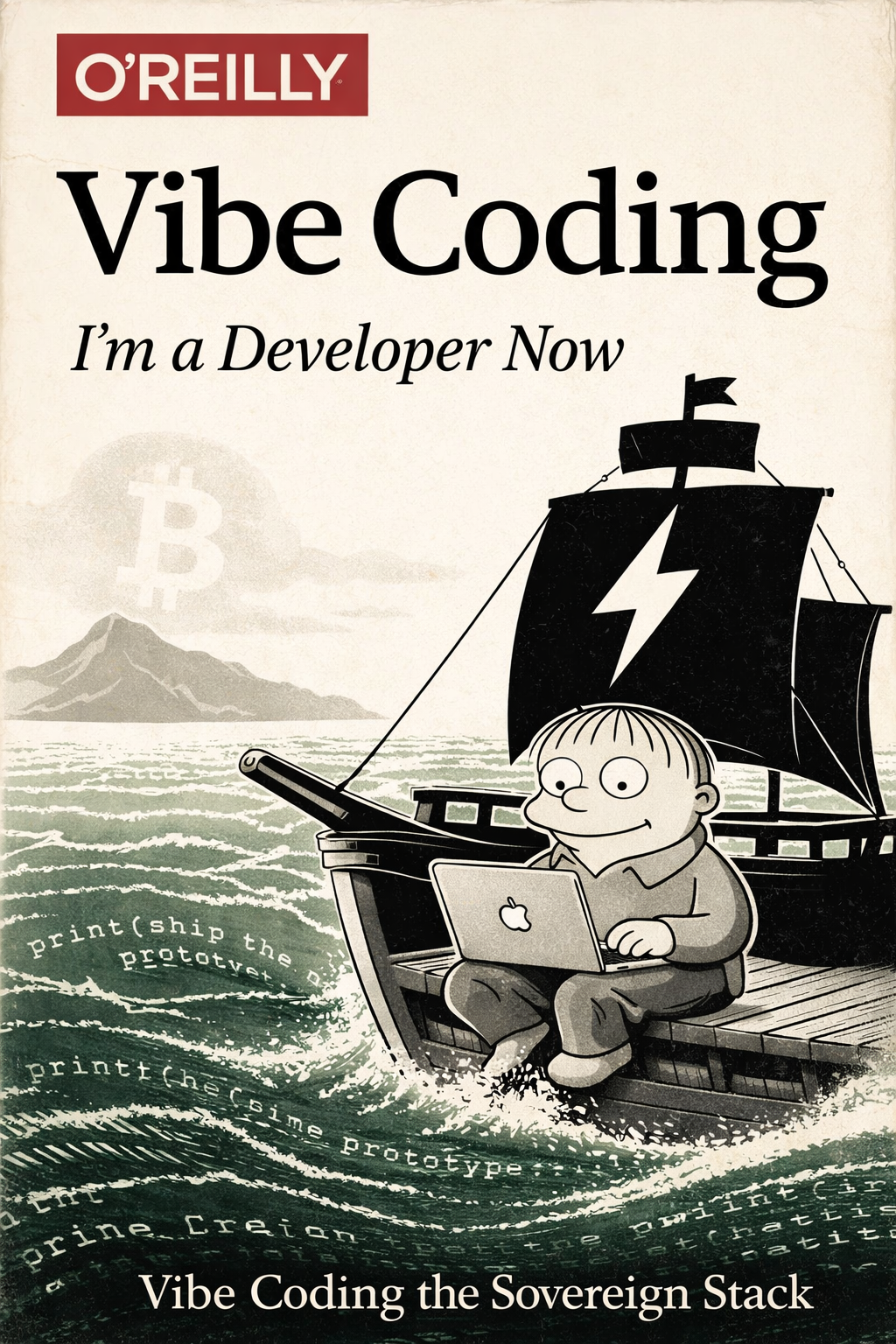
Look at the cover of this text. Really look at it.
Ralph Wiggum on a pirate ship. MacBook on his lap. Lightning bolt on the sail. Bitcoin moon rising over what is unmistakably a volcanic island. Code fragments dissolving into the Atlantic like messages in bottles that nobody asked for. The subtitle: I'm a Developer Now.
If this image makes you laugh, you get it. If it makes you feel seen, you might belong on the ship.
Applications for SEC-08 are open. But we'll get to that.
The Meme
There's a running joke in the Bitcoin community that all Bitcoiners are psychopaths.
This is slander. We are perfectly well-adjusted individuals who simply enjoy converting grocery prices into sats, explaining Austrian economics to Uber drivers, and running full nodes on hardware that costs more than our furniture.
But jokes encode truths, and the truth encoded in this one isn't about psychopathy. It's about a specific kind of brain. The kind that pulls on a thread and doesn't stop until the entire sweater is unraveled. The kind that reads one whitepaper and six months later has opinions about Byzantine fault tolerance, the Cantillon effect, and the thermodynamics of proof of work. The kind that looks at the global financial system and thinks: "This is a bug, not a feature."
These brains built Bitcoin. They built Lightning. They built Nostr. And someone—whether by genius or by accident—has built them an island.
The Island
Sovereign Engineering. Six weeks. Madeira. Twenty-one builders.
No company. No investors. No product manager. No Jira. No two-hour meeting that could have been a Nostr DM. Just people, code, and a demo every Friday.
Monday: orientation. Tuesday: talks. Wednesday: workshops. Thursday: build. Friday: demo day. Weekend: walk the levadas, argue about protocol design, stare at the Atlantic, and have the kind of conversations that don't happen on Zoom.
Every Friday you stand up and show what you built. Six minutes. Working code. Not slides. Not mockups. Not "we're still scoping the requirements." Code. Running. On screen. In front of the crew.
SEC-05 wrapped last October and it was productive chaos. Localhost maximalists, Routstr, Beacon, ContextVM, noDNS, Paygress, Spotstr—Friday demos ran long because everyone shipped multiple projects. Poncha-fueled evenings produced memes that became real code by morning. The energy was electric.
Earlier cohorts produced Zapstore, Tollgate, Nutzaps, Wikifreedia, Nsite, Blossom, and dozens more. Not hackathon demos that rot on GitHub. Running systems. Freedom tech that people actually use.
No VCs were harmed in the making of this infrastructure.
Why It Runs
I haven't been to Madeira. I don't know the crew. I've listened to the podcast "No solutions", read the philosophy page, and recognized something in the architecture.
The architecture is optimized for a very specific failure mode of conventional work: the brain that is brilliant in bursts and useless in steady states. The brain that mass produces code on a deadline but can't fill out a timesheet. The brain that understands cryptographic protocols intuitively but forgot to reply to that email three weeks ago.
The weekly cycle. Most jobs run on quarterly timelines. If your brain operates on novelty and urgency, that means eleven weeks of "I should really start this" followed by one week of "oh god, oh god, oh god." Sovereign Engineering compresses this into seven days. Every Monday is a blank page. Every Friday is a reckoning. Some brains only produce their best work at the edge of a deadline. This program puts the edge within permanent reach.
Demo Day. Six minutes. Working code. In front of everyone. This is not a status update you can sleepwalk through. This is a performance. And performances activate something that no amount of "please update your Jira ticket!!!" ever will.
The walks. Madeira's levadas are kilometers of cognitive runway. If you've ever solved a problem in the shower, on a run, or while doing the dishes, you know why this works. The program puts walking on the schedule because the best engineering happens away from the screen.
The filter. You have to fly to a volcanic island in the Atlantic and commit for six weeks. No salary. This alone eliminates ninety percent of the population. The remaining ten percent are the kind of people who hear "dangerous journey, no salary, safe return doubtful" and think: "When do we leave?"
Podcast "No solutions" mentions ADHD. About starting a new project every Monday and demoing it Friday. I think it's one reason the program ships more working code in six weeks than most companies ship in six months.
Vibe Coding the Sovereign Stack
The cover shows Ralph Wiggum writing code on a pirate ship. The water reads print(ship the prototype). That's not a punchline. That's a methodology.
Vibe coding has kicked down the gate between "real developers" and everyone else. A philosopher can ship a wallet. A podcast host can prototype a relay. You don't need a CS degree. You need a problem and the stubbornness to keep prompting until it compiles.
The Sovereign Engineering website says it in the footer: Vibed into existence. The philosophy page adds: We chase the 80–20, knowing that the last 20% can wait until the idea survives first contact with reality.
The 80% is where the insight lives. The 20% is where projects go to die. Building a culture around shipping the 80% and iterating in public is not laziness. It's the only honest way to build when nobody knows what the right answer is yet.
And look at what the 80% has produced. Tollgate: WiFi access for sats, no account, no KYC, no permission. Nutzaps: verifiable zaps on Nostr. Zapstore: app distribution without Apple or Google deciding what you're allowed to install. Wikifreedia: Wikipedia, but on a protocol no one controls. Nsite: web hosting that no government can take down.
These aren't demos. These are running systems. Freedom tech. Software that doesn't ask permission and can't be deplatformed.
Poor for Poor
Value for Value. Provide your work for free. Make it easy to give value back. No ads. No paywalls. No rent-seeking middlemen.
The polished version of this story is that it's the future of the open web. The honest version—and this framing comes from the community itself—is that it's poor for poor. People who don't have much, giving what they can to other people who don't have much.
The participants of Sovereign Engineering don't ship software that generates equity or acquisition offers. They ship software that generates freedom. For everyone. Including people who will never know who built it.
This is insane by fiat standards. By Bitcoin standards it makes perfect sense. Because this is exactly how Bitcoin itself was built. By pseudonymous individuals who saw something worth building and built it without asking. Without a business plan. Without permission.
Poor for poor. Until the poor turned out to be right and separated money from government control.
The Monastery on the Sea
The logo is a pirate ship. But pirates plunder. These people build. Pirates thrive in chaos. These people follow a weekly rhythm with the discipline of monks. Talk→ Build → Demo. Every week. Six weeks.
The pirate ship is a monastery.
People withdraw from the world. They sacrifice salary, comfort, career momentum. They live together, eat together, walk together. They follow a rhythm. And they do this not because they lack options, but because they've asked a different question.
Not: "What maximizes my compensation package?"
But: "What maximizes my sovereignty?"
Docker Pull Sovereignty
Zoom out.
Tollgate provides permissionless internet access. Cashu mints provide private, instant payments—no accounts, no identity, privacy by mathematics. Nostr relays provide censorship-resistant communication. Zapstore distributes apps no one can censor. Blossom stores data no one can delete. Lightning settles. Bitcoin secures.
Each piece is a module. Together they're an operating system for a sovereign community.
Madeira is v0.1. The world's first containerized sovereign economy. The components are open source. The architecture is modular. The documentation is being written in real time by people who keep showing up on Fridays.
When a relay goes down, another fills the gap—because filling gaps is profitable when the network pays in sats. Bitrot isn't a threat. It's selection pressure. What survives is stronger. What dies gets replaced.
The question isn't whether this can be replicated. The question is who runs docker pull next.
SEC-08: YOLO++
July 20 to August 28, 2026. Six weeks of summer in Madeira. Twenty-one builders.
This one is open exploration. Not a focused sprint. Bring your half-baked idea. Bring your project that needs momentum. Bring the thing you've been wanting to build but needed the right people around to make it real.
School's out. Bring your dog. Bring your family. Or come by yourself and leave with twenty new friends who understand why you run a full node.
Madeira is remote. Hard to reach. In-person only. That's not a limitation. That's the filter. That's how magic happens.
If you're building freedom tech—the protocols, infrastructure, and tools that no single entity can control—they want to hear from you. If you know someone who should be there, send them the link. If you looked at the Shackleton poster and felt a pulse, that's your signal.
Great weather. The ocean as far as the eye can see. Vibe to your heart's content.
Apply now: sovereignengineering.io
Fix the Money, Fix the Brain
One last thought.
Fiat rewards high time preference. Don't save. Consume. Your money loses value while you sleep.
Certain brains run the same firmware. Now, not later. The new, not the familiar. The stimulus, not the routine.
Bitcoin patches both.
For the monetary system: an asset that rewards patience. For certain brains: a rabbit hole deep enough to keep the hunger for novelty permanently fed—the protocol layers, the game theory, the cypherpunk history, the Lightning channels, the Nostr events, the Cashu nuts—while simultaneously hardcoding low time preference into the behavior. Hold. Stack. Build. Ship. Endure.
Fix the money, fix the web. That's the motto.
Maybe also: fix the money, fix the brain. Not as a cure. As an environment. One that stops punishing certain brains for being what they are. That treats hyperfocus as a feature. That ships the prototype on Friday and iterates next week. That understands poor for poor not as poverty, but as proof of work.
The ship is sailing. The cargo is freedom tech. The harbor is an island where you pay for coffee in sats and demo your code before sundown. The crew is made up of people who saw the poster and felt something.
You know who you are.
Cypherpunks write code - vibed into existence, one demo day at a time.
Sinautoshi
#Bitcoin only - #GetOnZero - united we fix the money (supply to 21M BTC)