There are stories that don’t arise in boardrooms, not at conferences, and not in the glossy magazines of the financial world. They arise at the margins. In workshops, on scrapyards, at glass containers. Where hands are still allowed to grow calloused and work still leaves traces. Where PoW — real, physical Proof of Work — is not just a consensus mechanism, but a way of life.
This story is about two people. We call them the Welder and the Collector.
Both are invisible architects of a new era. Both are upcycling activists not because it’s trendy, but because it’s necessary. Both belong to that inconspicuous, often ridiculed, sometimes romanticized group the Bitcoin world calls “plebs.” But “pleb” is not a stigma. It is a badge of honor. It describes those who don’t wait for permission. Who simply act.
And they make Bitcoin glow.
The Welder of the Flame
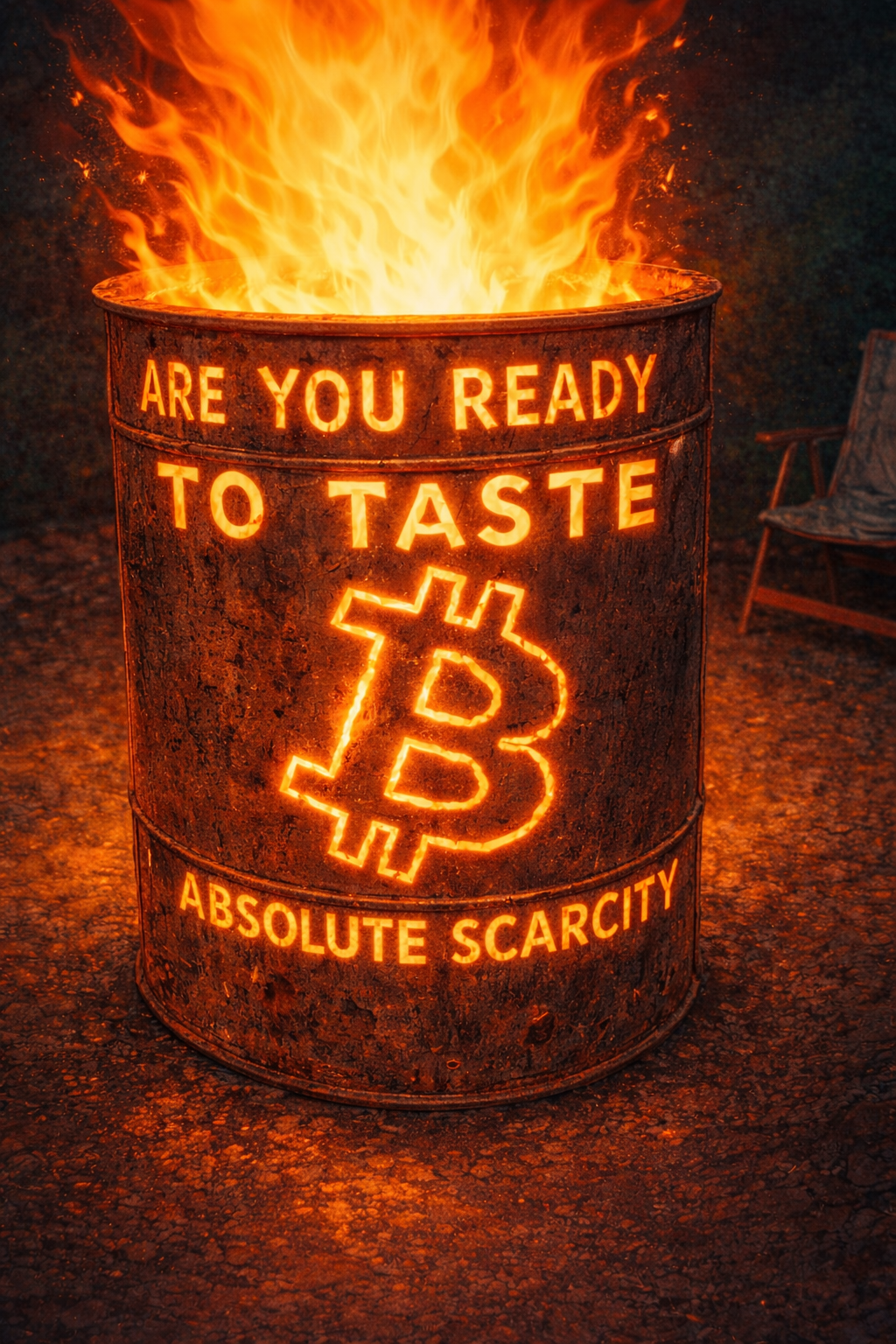
He works with fire, standing in a workshop where metal smells like old stories. In front of him: discarded oil drums, resting peacefully on the scrapyard. For others it’s just scrap, but for him they are fireproof canvases for eternity.
With a plasma cutter he etches symbols and his visions into steel. Bitcoin logos and messages for a future we are only just beginning to understand. Sometimes he burns the Anonymous mask into the metal — a reminder that freedom and privacy are profoundly human rights. Sometimes it’s just words: “some people just want to see central banks burn.”
And when the flame dances, cold metal becomes glowing art.
At night, these burn barrels are more than fireplaces. They are signals. Orange-glowing runes in a world of fiat paper and decaying stores of value. People sit around them, talking, thinking, philosophizing. Simple conversations about difficult things. Energy flows from wood into flame, from flame into people’s eyes.
Fire brings Bitcoin into the physical world. Not as an investment vehicle, not as a speculative object, but as a symbol. A sign that value is something real. That energy and labor can merge and materialize in a new form: harder, digital, censorship-resistant.
He welds art — but he also welds meaning. He transforms the old into the new. The defective into value. He shows that capital is not just numbers on a screen, but energy, responsibility, creative power.
And every time the sparks fly, Bitcoin glows a little brighter.
The Collector of the Lost
The second pleb works differently — he needs no welding torch, no workshop, no audience. He is quiet. Invisible — overlooked by most. He collects what consumer society carelessly throws away: deposit bottles.
Eight cents here. Fifteen cents there. The difference doesn’t matter. Only one thing matters: nothing is lost. No deposit leakage. No value slipping back into the pockets of the big supermarkets.
It is a silent form of capital recovery. Civilizational alchemy. Lost euros are turned into satoshis — the smallest units of an incorruptible digital good. What once lay in the street now accumulates in a wallet. Unobtrusive. Steady. Unspectacular.
Ten years ago you could get between 220,000 and 670,000 satoshis for one euro. A small backpack full of bottles — back then maybe just loose change — would today be a small fortune. No lottery, no luck. Just effort. Just discipline. Just time.
The collector does not work with flames. He works with patience. With a time preference so low it can hardly be measured. He believes the future is worth more than short-term consumption now. And Bitcoin is his vehicle to manifest that belief.
He lifts capital off the ground.
And feeds it into the timechain.
Two Paths, One Truth
They differ greatly — and yet they mirror the same idea.
The Welder makes Bitcoin visible.
The Collector gives Bitcoin more value.
The Welder lights flames that gather people. He reminds us that value is something that glows, warms, connects. Something born of energy.
The Collector reminds us that capital need not be lost — that it can be recycled, preserved, conserved. That wealth does not arise from risk, but from consistency. From responsibility.
Together they embody the essence of the Austrian School of economics. Where value is subjective, action intentional, and time preference the decisive variable. While the fiat system devalues time, Bitcoin enforces responsibility. Those who save satoshis gift their future selves resources. Those who waste them rob it.
Ludwig von Mises might have said: “Economics is human action.” And the Welder and the Collector act. They decide. They trade leisure for future. Comfort for freedom. They work with real PoW — not only on the blockchain, but in life.
Time Preference — The Greatest Invisible Force
Time preference means: how much do you favor the present over the future?
Fiat money systems raise time preference. Inflation acts like constant dripping on the soul: Spend. Now. Immediately. Tomorrow is worth less. Don’t save. Go into debt. Buy. Consume. Keep spinning on the hedonistic treadmill.
Bitcoin reverses that.
Because Bitcoin is a storage for time.
Satoshis are condensed life energy. They are the result of sweat, mental labor, risk, production, service. And because Bitcoin is hard — non-dilutable, finite — time is suddenly re-evaluated. The future gains weight. Long-term thinking becomes rational.
The Welder’s burn barrels — they may still exist decades from now. Metal is patient. The flames within them symbolize a fire that will not go out: that of monetary truth.
And the Collector’s bottles — they disappear, yet their essence remains. They are absorbed into the timechain. A global ledger of human labor, sealed by energy, distributed across space and time.
Every barrel, every bottle is an act of low time preference.
A no to the quick kick.
A yes to the future.
Bitcoin as Economic Gravity
In a free market, good money drives out bad — not the other way around. People hold hard money and spend soft money. Known as Gresham’s Law — in its deeper, truer form.
The Welder creates symbolic centers — places where conversations begin, value is reconsidered, people grow curious. His burn barrels are like lighthouses in the fog of the fiat age. They remind us that truth burns. That it may be seen.
The Collector, by contrast, is an invisible black hole for lost capital. He gathers small remnants of the fiat ocean and compresses them into the singularity of the hardest digital capital. Every cent once thrown away becomes part of a global, decentralized vault.
The Austrian School emphasizes that value is always subjective — and yet millions of individual valuations produce an emergent market price. Just as the millions who hold satoshis create a price that increasingly reflects the true energy input of the world.
Bitcoin forces honesty.
Work for work.
Time for time.
Value for value.
No more.
No less.
Proof of Work — Beyond Hashrate
The term “Proof of Work” predates Bitcoin. At its core it means: you prove your claim through effort. Through energy. Through commitment.
Their PoW is not a competition for blocks, but for meaning. They take resources — old drums, empty bottles — and transform them. They give them a new path in life.
And that path does not end in the trash.
It ends in the timechain.
Bitcoin shows us that “digital” does not mean “unreal.” Rather: digital is the highest form of order we’ve yet achieved in the monetary sphere. An order based on energy, not promises. On mathematics, not politics.
When the Welder fires up his plasma cutter and sparks fly, he feels: energy is real.
When the Collector feeds his bottles into the machine, he feels: responsibility is real.
Both convert that reality into satoshis.
The hardest capital of the 21st century.
The Invisible Heroes of Hyperbitcoinization
Hyperbitcoinization will not be triggered by hedge funds.
Not by ETFs.
Not by governments.
But by millions of inconspicuous people who lower their time preference and act every day as if there is a future worth striving for.
The plebs are not a mob.
They are the vanguard of a new economy.
They are archetypes.
The Artist.
The Collector.
The extrovert.
The introvert.
Both say: I do not trust words. I trust work. I trust energy. I trust a system that belongs to no one — and yet serves everyone.
Bitcoin does not just glow orange.
It glows human.
The Glowing Green
The Collector often jokes: “At the end of the day, the daily Bitcoin candle glows a little green.” Not in the ecological marketing sense of the old world, but in the deep economic sense:
Value that would have been wasted finds a purpose.
It is a silent capital flow. Not noticeable, not really measurable, not spectacular — and yet real. It changes nothing in the global price structure — and yet changes everything inside a person. Because those who save take responsibility for their future selves. And from that arises culture. Ethos. Dignity.
Bitcoin is not just hard money.
Bitcoin is a moral technology.
A Backpack Full of Satoshis
Ten years ago, a small backpack full of bottles would have yielded two, maybe three euros. And a single euro would buy 220,000 to 670,000 satoshis. Back then just a meager hourly wage — today more than some lawyers earn.
This is not romanticization.
It is a reminder.
That time works.
That consistency compounds.
That small decisions carry the greatest meaning.
The Barrels and the Timechain
At the end of this text stand two images:
A barrel into which symbols have been burned. It stands somewhere in the night. People gather around it. Children gaze into the flame. Words arise, thoughts circle. Bitcoin glows.
And a simple person picking up a bottle. Then another. And another. Not out of need. Out of responsibility. Out of principle. He feeds them into the machine. And the timechain breathes them in.
Both express the same truth:
Value arises from work.
The future arises from low time preference.
And Bitcoin is the monetary mirror of this insight.
The plebs do not just make Bitcoin glow.
They teach us what it means to be human again — to act, to think, to be responsible — in a world that had grown too accustomed to lies.
And perhaps that is the true spark that makes Bitcoin glow.
- plebs
- Originals
- artist
- freedom
- hyperbitcoinization
- english
- lang:en
- level:novice
- read:medium
- author:sinautoshi
- topic:philosophy
- topic:basics
- topic:hyperbitcoinization

Sinautoshi
#Bitcoin only - #GetOnZero - united we fix the money (supply to 21M BTC)



Related Posts
Die Plebs die Bitcoin zum Leuchten bringen
Dec 28, 2025
A Short Tale of Freedom: Bitcoin vs. CBDC – Can Sovereign Minds Outlast Brusselsgrad?
Jun 04, 2025
we are not the same
Jun 08, 2024